
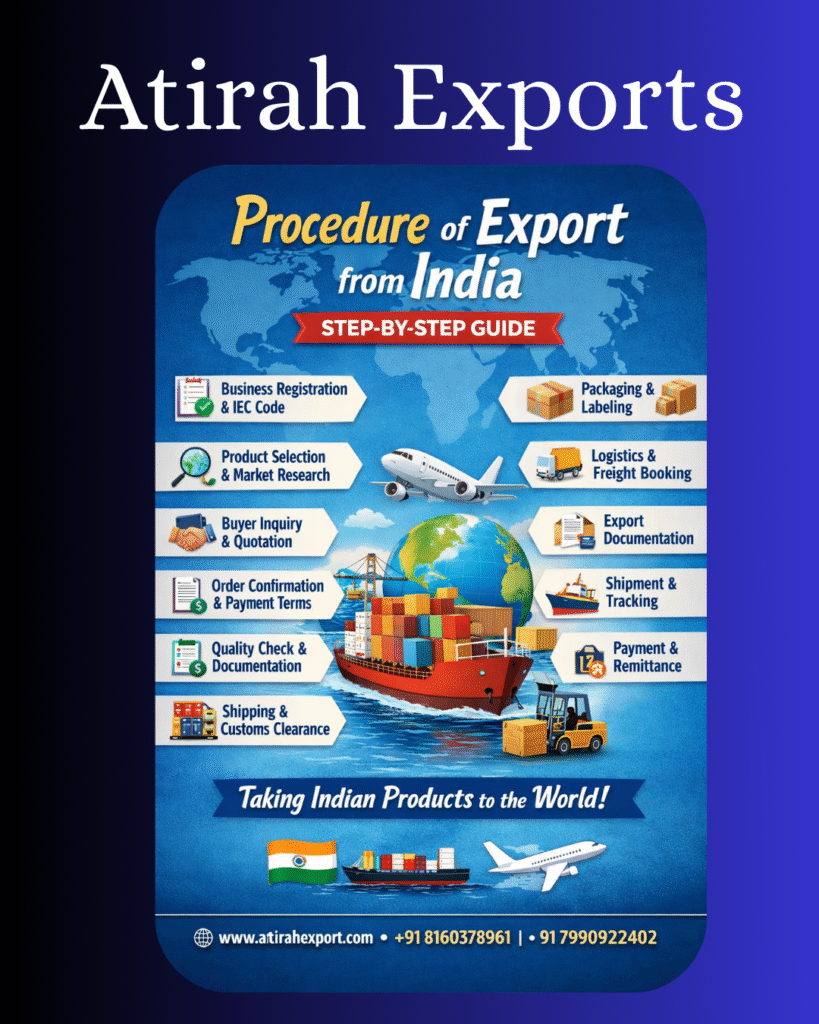
Introduction
Exporting goods from India is a structured and regulated process that ensures smooth international trade. For new exporters, understanding the procedure of export is essential to avoid errors, delays, and financial losses.
This guide explains the complete export procedure from India, covering documentation, compliance, logistics, and payment methods—presented in a simple and practical manner.
1. Business Registration & IEC Code
The first step in starting exports from India is business registration. Exporters must obtain an Import Export Code (IEC) from the Directorate General of Foreign Trade (DGFT).
- Mandatory for all exporters
- One-time registration
- Valid for lifetime
2. Product Selection & Market Research
Choose exportable products based on demand, compliance feasibility, and sourcing capacity. Market research helps in identifying:
- Target countries
- Import regulations
- Pricing trends
- Competitor analysis
3. Buyer Identification & Inquiry Handling
Exporters receive inquiries through trade portals, emails, or references. A professional response should include:
- Product specifications
- Packaging details
- MOQ
- Pricing terms (FOB / CIF)
- Delivery timelines
4. Quotation & Proforma Invoice
After understanding buyer requirements, a Proforma Invoice (PI) is issued. It includes:
- Product description
- HS Code
- Quantity & price
- Incoterms
- Payment terms
- Port of loading & destination
5. Order Confirmation & Payment Terms
Once the buyer agrees, order confirmation is received. Common payment methods include:
- Advance Payment
- Letter of Credit (LC)
- Documents Against Payment (DP)
- Documents Against Acceptance (DA)
6. Pre-Shipment Compliance & Quality Check
Depending on the product and destination, exporters may require:
- Phytosanitary Certificate
- Fumigation Certificate
- Certificate of Analysis (COA)
- Inspection reports
7. Packaging, Labeling & Stuffing
Goods are packed as per buyer specifications and international standards. Proper labeling includes:
- Product name
- Net weight
- Country of origin
- Batch number
Stuffing is done at factory, warehouse, or port under supervision.
8. Shipping & Logistics Arrangement
Exporters coordinate with freight forwarders for:
- Container booking
- Vessel schedule
- Shipping Bill filing
- Customs clearance
9. Export Documentation
Essential export documents include:
- Commercial Invoice
- Packing List
- Shipping Bill
- Bill of Lading (BL)
- Certificate of Origin
- Insurance (if applicable)
10. Shipment Dispatch & Tracking
After customs clearance, cargo is loaded and shipped. Exporters share BL copy and tracking details with the buyer.
11. Post-Shipment & Payment Realization
Final documents are submitted to the bank for payment realization. Exporters must ensure:
- Timely document submission
- Follow-up for payment
- GST refunds & export incentives (if applicable)
Conclusion
The export procedure from India involves careful planning, accurate documentation, and reliable execution. When done professionally, exporting opens doors to global markets and long-term business growth.
Working with experienced merchant exporters ensures smoother operations, reduced risk, and buyer satisfaction.