
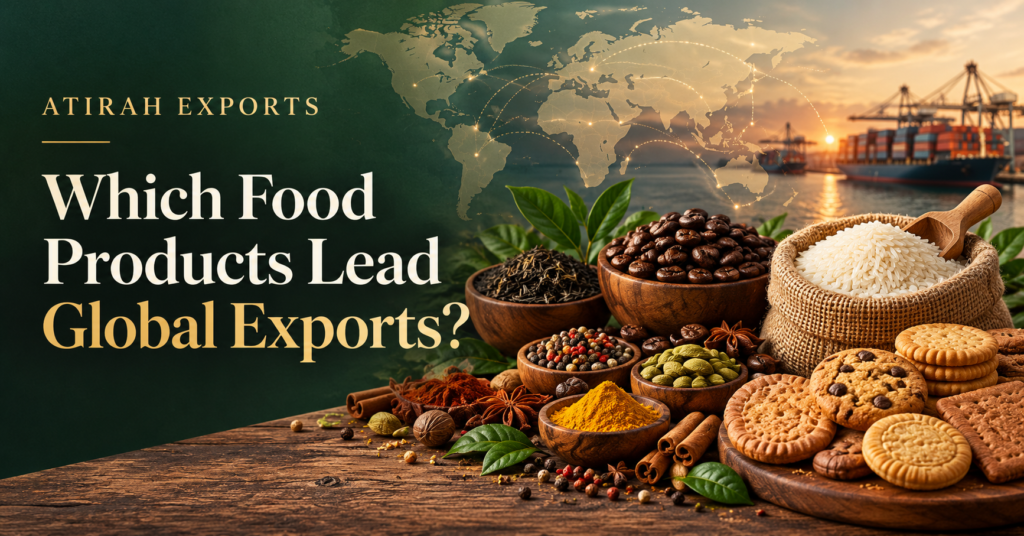
Which Food Products Are Exported the Most: Rice, Tea, Coffee, Spices, or Biscuits?
SEO title: Most Exported Food Products: Rice, Tea, Coffee, Spices & Biscuits
Slug: most-exported-food-products-rice-tea-coffee-spices-biscuits
Meta description: Compare the global export markets for rice, tea, coffee, spices, and biscuits, and learn which products lead by trade value and export volume.
From everyday staples to packaged snacks, food products move across borders in enormous quantities. But among rice, tea, coffee, spices, cookies, and biscuits, which products are exported the most?
There isn’t one answer for every measure. Rice stands out for export volume, while coffee is a major global trade by value. Tea, spices, and biscuits also have strong international markets, each with different buyers and business opportunities.
Rice: A major export by volume
Rice is a staple food for billions of people, creating steady demand in markets around the world. In 2024, India was the largest rice exporter by value, with exports of about US$11.6 billion. Thailand and Pakistan followed. World Bank WITS rice trade data
Rice is usually traded in large quantities, so it is a leading product when measured by volume. Exporters may offer different varieties, including basmati, parboiled, jasmine, and long-grain rice. Each variety serves different consumer preferences and market requirements.
Coffee: A high-value global trade
Coffee is one of the most widely traded products in the group. The FAO reports that world coffee trade exceeded US$34 billion in 2024. FAO coffee facts and data
Brazil was the largest exporter in the World Bank’s 2024 category for coffee, tea, maté, and spices, with exports valued at about US$11.85 billion. This category combines several products, so it should not be read as coffee-only data. World Bank WITS product group data
Coffee exports include green beans, roasted coffee, and processed products. The product form, origin, quality grade, and processing method all affect its buyers and price.
Tea: Strong demand and established exporters
Tea has a substantial international market, with China, Kenya, and Sri Lanka among the leading exporters in 2024. Their reported exports were each worth roughly US$1.4 billion. World Bank WITS tea trade data
Export opportunities include black tea, green tea, specialty varieties, and blends. Buyers may be wholesalers, retailers, beverage brands, or food-service businesses. Packaging and product specifications often vary by destination market.
Spices: A diverse export category
Spices are traded individually and in blends, with products such as pepper, turmeric, chili, cardamom, and cumin serving different culinary and manufacturing markets. Since trade data may group spices with coffee, tea, or other products, it can be difficult to compare the category directly with rice or biscuits.
For exporters, the range of products creates options for serving bulk buyers, ingredient suppliers, food manufacturers, and branded retail markets. Consistent quality and clear product specifications help buyers assess a supplier.
Cookies and biscuits: Packaged products with global reach
Cookies and biscuits are exported as finished, packaged foods. Global exports of biscuits and crackers were estimated at approximately US$11.5 billion in 2024 in an industry report drawing on UN Comtrade data. PACRA food products report
Unlike bulk commodities, biscuits are branded consumer products. Exporters must consider packaging, shelf life, ingredients, labeling, and the preferences of buyers in each destination market.
So, which product is exported the most?
The answer depends on how exports are measured:
- By volume: Rice is a leading product because it is shipped in very large quantities.
- By trade value: Coffee is a major global trade, with world coffee trade exceeding US$34 billion in 2024.
- Within tea: China, Kenya, and Sri Lanka were among the top exporters by value in 2024.
- Among packaged foods: Biscuits and crackers represent a sizable international market.
These figures use different trade categories and sources, so they are not a perfect one-to-one ranking. They do show that all six product types—rice, tea, coffee, spices, cookies, and biscuits—have established international demand.
Choosing a product for export
The largest market is not automatically the best fit for every exporter. Before choosing a product, consider your supply capacity, target buyers, product quality, packaging needs, destination requirements, and competition. A focused product range and a clear understanding of the target market can help build a stronger export business.
In summary: rice leads in shipment scale, coffee is a very high-value global trade, and tea, spices, and biscuits each offer distinct opportunities for exporters.